
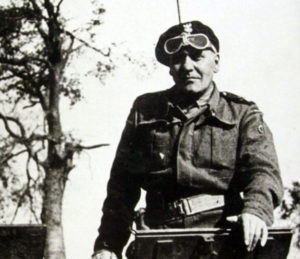
Stanislaw Maczek was born on the 31st of march 1892 in a small town, not far of Lwow, in the Austrio-Hungarian Empire. He studied polish philosophy. Soon after the outbreak of World War I, he was mobilized and started his military career in the Austro-Hungarian army. He received many promotions and decorations for his commandeering talents.
When the Hapsburg monarchy fell off in November 1918, he escaped the Austro-Hungarian army and enlisted the Polish army. He fought for independence at the border of Poland and was praised for his bravery and his ability to make decisions in the battlefield. Commander of the 10th Cavalry Brigade, he was given the task of commanding large motorized troops, which was a real innovation back then, in fact, it was the very first armored division of the polish army.
Poland was attacked and invaded on September 1st, 1939. Able to inflict losses on the German forces, He was awarded the gold cross of the war order of Virtuti Militari and was promoted General of the 10th Brigade. The 10th Brigade was ordered to evacuate Poland after the Soviet invasion of 17th September 1939. They arrived in France, were they fought, alongside the French army, to defend the country facing a brutal German invasion. After France defeated, Maczek’s unit escaped and landed in England. In February 1942, he managed to put together the exhausted units of the Polish Amry and created the 1st Polish Armored Division.
The 1st armored polish division arrived in Normandy on august 1st, 1944 and was composed of 16 000 men and 400 tanks. Attached to the Canadian army to reinforce the 2nd Canadian Corps, they fought one of the Normandy fiercest battle : the Falaise Pocket.
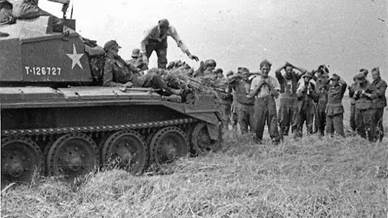
On august 19th, the 1st polish armored division preceding the 1st Canadian Army launched the final push out to close the Falaise pocket. Totally isolated and surrounded by the German forces, they saw violent and bloody fights nearby Chambois. Despite the lack of supplies and heavy losses they held the Hill 262 till the Canadian forces arrive.
“Thank you, Poles”
Maczek’s unit took part in the liberation of Belgium, the Netherlands, and Germany where they saw the capitulation of the Commander of the Kriegsmarine. Always welcomed as heroes in each lil town they have liberated.
Even if the war was coming to an end, the 1st Division was ordered to set up a Polish occupied zone on the Dutch-German border, nearby the city of Haren. Haren became an informal capital, streets were given polish names, thousands of polish prisoners and insurgents found shelter in Haren. However, because of the soviet pressure, the poles had to leave the city in 1948.
In fact, in February 1945, Roosevelt, Churchill and Stalin met at Jalta, Crimea, in order to decide what the after-war world would look like. They have agreed on sharing Germany and they have also decided to redraw the polish-USSR border, meaning that Poland was in Stalin’s hands.
Maczek and his men had been willing to sacrifice their lives for the freedom of Poland, they have escaped Nazi only to fall under Soviet domination.
“I myself, was born in Lwów, which had never, not even during the time of Poland’s three partitions, been under the rule of Russia, and now, it was so uncritically, being given to Russia. To this, Montgomery interrupted me, with a smile and said that in that case, everything was perfectly arranged, because I could now be a Russian general. That was too much for me.”
After the war, Maczek, as many thousands of Poles, was not able to return to his homeland now under Communist rule. He was deprived of his Polish citizenship and settled in Edinburgh, Scotland where he worked as a salesman and a barman.
Stanislaw Maczek died in Edinburgh on December 11st, 1994 at the age of 102. He was buried at a Polish cemetery in Breda, Netherlands, amongst his soldiers.
Source :
https://polishhistory.pl/general-stanislaw-maczek-and-the-black-devils
https://www.junobeach.org/fr/canada-in-wwii/articles/les-allies-polonais-du-canada-en-normandie
About the 1st Polish Armored Division in Normandy
Polish military cemetery